




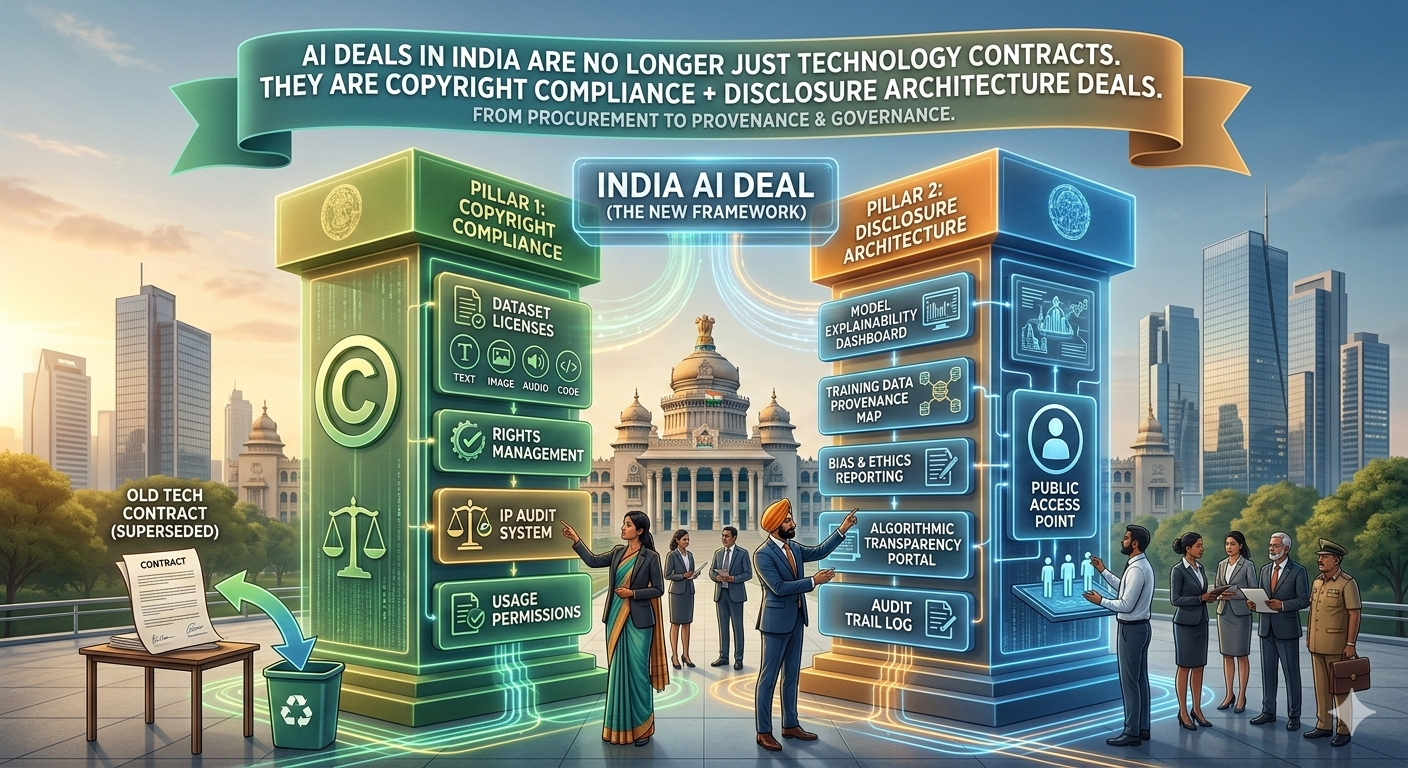
AI contracts in India are no longer simple technology agreements.
Today, every AI deployment in India triggers copyright compliance obligations, data protection requirements, and disclosure architecture decisions that standard SaaS or software integration contracts do not address. In-house counsel and foreign advisors who treat AI contracts in India as routine technology procurement are creating contractual gaps that Indian courts will eventually fill — on terms neither party anticipated.
The disputes will come. The question is whether today’s agreements will hold up when they do.
Why AI Contracts in India Require a Different Framework
Most AI collaborations in India are still documented as software integration agreements. However, this framing is incomplete. An AI deployment today activates at least five distinct legal layers that standard technology contracts ignore entirely.
Understanding these layers is no longer optional. It is the baseline for competent AI contract drafting in India.
1. Copyright Risk in Training Data and Outputs
AI contracts in India must address copyright compliance at the training data level.
Under the Copyright Act, 1957, several questions demand contractual answers. First, was the training corpus licensed for the purpose the developer used it? Second, does ingestion of copyrighted material during training constitute reproduction under the Act? Third, who owns AI-generated outputs when the system trained on third-party works?
Indian courts have not yet settled these questions. Therefore, counsel must engineer the answers contractually — through training data warranties, output ownership clauses, and indemnification structures that allocate copyright liability before it becomes a dispute.
2. Intermediary and Platform Liability
Moreover, the Information Technology Act, 2000 creates intermediary liability exposure that AI contracts must address directly.
When an AI platform generates harmful or infringing content, liability allocation between the platform provider and the enterprise deployer depends entirely on what the contract says. Specifically, the agreement must address who handles takedown notices, who carries the indemnity obligation, and what response timelines govern the relationship.
Without these provisions, the enterprise user absorbs platform-level risk by default. Furthermore, this outcome is entirely avoidable at the drafting stage.
3. Data Protection Architecture Under the DPDP Act
Additionally, AI contracts in India must now embed data governance as primary contract architecture — not as a compliance annexure.
The Digital Personal Data Protection Act, 2023 directly affects how AI systems can collect, process, and transfer personal data. Consequently, every AI agreement must address whether personal data was used in training, whether anonymisation meets the statutory standard, and whether cross-border data transfers comply with the framework.
In short, data protection under the DPDP Act is a contract design question, not a legal schedule question.
4. Disclosure and Explainability Obligations
Similarly, in regulated sectors such as fintech and health-tech, AI contracts in India must address disclosure obligations clearly.
Are users informed that decisions are AI-driven? Is auditability built into the system architecture? Can automated decisions be explained to regulators and affected parties? Silence on these questions is not a neutral position. Indeed, silence is exposure — regulatory, contractual, and reputational.
5. Ownership of Improvements and Derived Assets
Finally, and most significantly, AI contracts in India must address ownership of what the deployment relationship produces.
The real disputes will arise over fine-tuned models, prompt libraries, derived datasets, and improvement rights. These assets carry substantial commercial value. Nevertheless, today’s AI agreements almost uniformly fail to address them with adequate precision.
When ownership disputes surface — and they will — parties will litigate the question their contract should have answered from the start.
What This Means for In-House Counsel and Foreign Advisors
AI contracts in India now require a drafting standard that reflects the actual complexity of what the parties are transacting.
An agreement that omits training data provenance, output ownership, intermediary liability allocation, DPDP Act compliance architecture, and improvement rights ownership is an incomplete agreement — regardless of how detailed its commercial terms appear.
The contracts executing today will face interpretation by Indian courts and tribunals in the years ahead. Therefore, the time to build precision into these agreements is before signing — not after the dispute has begun.

Comments are closed