




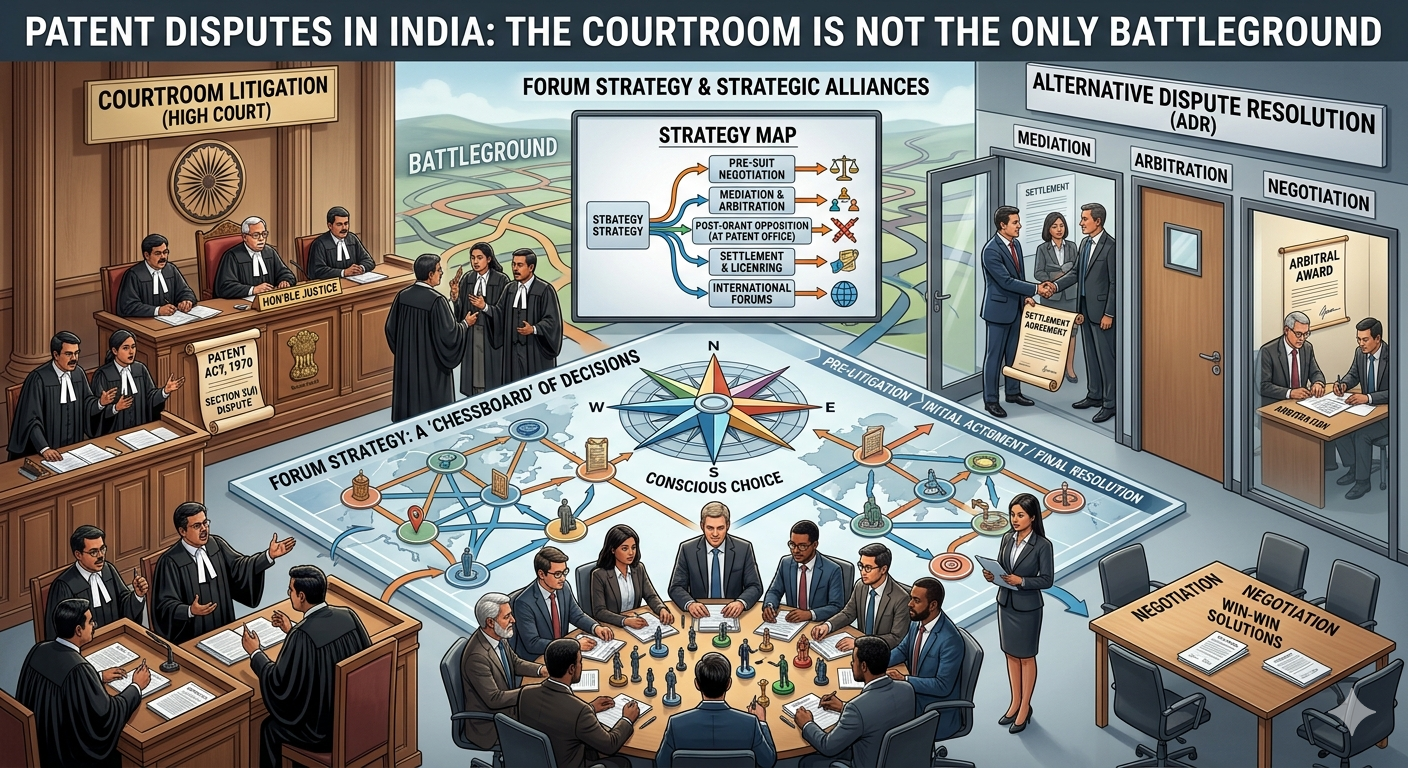
Patent disputes in India are rarely decided only in courtrooms — and the parties who consistently achieve better outcomes are the ones who understood that before the dispute began.
In cross-border technology and pharmaceutical matters involving Indian patents, the decisive moves are frequently made in meeting rooms, in early correspondence, in the framing of the first notice, and in the relief sought in the first filing. By the time a case number is generated, the strategic position of each party has often already been significantly shaped — by choices made months or years earlier, in contexts that did not appear to be litigation decisions at the time they were made. Sometimes the most important dispute in a patent matter never reaches a courtroom at all. It is resolved — or irresolvably complicated — through a combination of contractual forum selection, patent office proceedings, regulatory pathways, and commercial negotiations whose outcome depends entirely on which party built the better pre-dispute architecture.
Understanding patent disputes in India therefore requires understanding a landscape that extends well beyond the procedural framework of High Court litigation — and that begins, in every case, at the contract and relationship stage that precedes the dispute by years.
The Typical Pattern in Cross-Border Patent Disputes Involving India
Patent disputes in India involving foreign companies follow a pattern that, once recognised, is strikingly consistent across technology and pharmaceutical sectors.
A foreign company builds a global patent portfolio. India is an important market — large enough to require dedicated commercial attention, complex enough to require local partners. Distribution agreements are put in place. Licensing structures are negotiated. Technology transfer arrangements are documented. The contracts governing these relationships contain jurisdiction and governing law clauses that the parties treat as standard. Everyone assumes that any serious disagreement will be resolved through the High Court or through the arbitration clause that the agreement contains. The parties plan their commercial relationship around that assumption.
For a period, the system appears stable. The commercial relationship functions. The patent portfolio provides the background protection against which the licensing and distribution arrangements operate. The jurisdiction clause sits in the agreement, unread and unreferenced.
Then a dispute appears. It may be about product quality. It may be about territorial restrictions. It may be about pricing and margin allocation. It may be about the technology itself — about what the licence covers, what improvements belong to whom, what happens when the licensed technology evolves beyond the scope of the original agreement. At the moment the dispute surfaces, each party reaches for the contractual provisions they believe govern the resolution process.
One side points to the arbitration clause. The other side points to the Patents Act. Suddenly, the question that seemed settled by the contract — where does this dispute go — becomes genuinely unclear. And the answer to that question will determine everything that follows: the timeline, the available remedies, the interim relief options, the cost structure of the dispute, and the commercial leverage of each party throughout the resolution process.
Why the Arbitrability Question in Indian Patent Disputes Is Not Settled
Patent disputes in India sit at an intersection of contract law and statutory IP law that produces genuine uncertainty about forum — uncertainty that the parties’ contractual choices do not fully resolve and that Indian courts have not yet addressed with the consistency that commercial parties require.
The starting point is the general principle that disputes involving registered IP rights — patents, trademarks, designs — have an in rem dimension that affects rights against the world and therefore requires adjudication by statutory tribunals or courts, not by private arbitral tribunals. On this analysis, disputes about patent validity, patent revocation, and compulsory licensing are not arbitrable — they involve public rights that cannot be privately resolved between the parties to a commercial agreement.
The competing principle is that disputes arising from contracts that involve IP — licensing agreements, technology transfer arrangements, distribution contracts — are in personam disputes between the contracting parties and are therefore fully arbitrable. On this analysis, a licensing dispute about royalty calculation, territorial scope, or improvement rights is a contractual dispute that happens to involve IP — and the arbitration clause in the underlying contract governs it in the same way it governs any other contractual dispute.
The difficulty is that most real patent disputes in India do not fit neatly into either category. A licensing dispute that begins as a disagreement about royalty calculation may require the arbitral tribunal to assess the scope and validity of the licensed patents as a preliminary question. A technology transfer dispute that begins as a contractual claim may require resolution of questions about patent ownership that have implications beyond the immediate parties. The line between a private contractual dispute and a dispute touching public IP rights is frequently blurred — and Indian courts and arbitral tribunals have drawn that line inconsistently across different benches and different factual contexts.
Furthermore, Section 47 of the Patents Act and related provisions create mandatory features of Indian patent law that contractual choice of law and forum selection cannot override. The interaction between these mandatory provisions and the parties’ contractual arbitration architecture creates a layer of complexity that most standard dispute resolution clauses were not drafted to address — and that produces precisely the forum uncertainty that sophisticated parties most need to avoid.
Why the First Notice and First Filing Are More Consequential Than the Contract
Patent disputes in India are shaped not only by the contractual provisions that govern them but by how the dispute is framed from the moment it first becomes visible — and this is the dimension of Indian patent dispute strategy that foreign counsel and in-house teams most consistently underestimate.
The way a dispute is characterised in the first notice matters. A notice that frames the disagreement primarily as a contractual dispute — about what the licence covers, what the parties agreed, what obligations have not been performed — positions the matter differently from a notice that leads with patent infringement or validity challenges. The framing of the first notice affects how the counterparty responds, what forum they seek to invoke, and what strategic options they preserve or foreclose.
The relief sought in the first filing matters equally. A party that files for injunctive relief in the High Court on the basis of patent infringement has made a forum choice — one that the other side will respond to, and that may affect the subsequent enforceability of any arbitration clause in the underlying contract. A party that commences arbitration on the contractual claims while simultaneously filing opposition proceedings at the Patent Office has made a different set of choices — ones that preserve some options while committing to others.
The parallel use of opposition proceedings and regulatory pathways adds a further dimension. Patent office proceedings — pre-grant oppositions, post-grant oppositions, revocation applications — operate on timelines and through mechanisms that are entirely separate from both court litigation and arbitration. A party that uses patent office proceedings strategically, in parallel with or in advance of court or arbitral proceedings, can affect the validity landscape of the disputed patents, create delays in the opponent’s enforcement timeline, and generate a public record that affects the credibility of the opponent’s position in subsequent proceedings.
Additionally, and perhaps most consequentially, the conduct of the parties over the life of the commercial relationship creates what Indian courts describe as settled expectations — a history of behaviour that courts consider when resolving ambiguities in forum selection provisions and when assessing the credibility of each party’s position on jurisdictional questions. A party whose conduct over several years was consistent with treating certain disputes as contractual — through negotiation, through escalation to senior management, through reference to commercial dispute resolution mechanisms — may find that this history influences the forum question in ways that the literal wording of the arbitration clause does not support.
Two Consequences for Foreign Counsel and In-House Teams
Patent disputes in India produce two consequences for foreign counsel and in-house teams that apply regardless of the specific sector, technology, or commercial structure involved.
The first consequence is that forum strategy cannot be an afterthought. The jurisdiction and governing law provisions in licences, technology transfer agreements, and distribution arrangements are not boilerplate. They are live tools in later disputes — tools whose effectiveness depends on how precisely they were drafted, how consistently the parties behaved in accordance with them, and how well they interact with the mandatory features of Indian patent law that no contractual provision can override.
Building forum strategy into the drafting stage means more than selecting an arbitral institution and specifying a seat. It means identifying, in advance, the categories of dispute that are most likely to arise from the specific commercial relationship — royalty disputes, scope of licence disputes, improvement ownership disputes, territorial restriction disputes — and assessing how each category sits against the arbitrability framework that Indian courts will apply. It means drafting the arbitration clause with specific awareness of the mandatory features of Indian patent law that will affect what the tribunal can and cannot decide. And it means ensuring that the choice of law and jurisdiction provisions are internally consistent — that the governing law, the seat of arbitration, and the provisions for interim relief all point in the same direction rather than creating conflicts that a counterparty can exploit at the moment of maximum commercial pressure.
The second consequence is that early correspondence requires discipline once a conflict becomes visible. Emails, notices, and internal notes created in the period between the first signs of a dispute and the commencement of formal proceedings are not merely business communications. They are evidence — evidence that courts and arbitral tribunals will examine when assessing each party’s position on forum, urgency, delay, and the characterisation of the dispute. The discipline required is not complexity. It is consciousness: a deliberate awareness, from the moment a conflict first appears, of whether the correspondence being created supports the forum strategy being pursued, preserves options that should be kept open, and avoids characterisations that could be used to argue against the chosen forum.
The Practice of Forum Mapping in Indian Patent Disputes
Patent disputes in India benefit from a structured exercise — forum mapping — that makes explicit the choices that most parties make implicitly, and often inconsistently, as disputes develop.
Forum mapping begins with identifying the reliefs that actually matter commercially. Not the full range of legally available remedies, but the specific outcomes that would determine whether the dispute represents a commercial win or loss — the injunction that would stop a competing product, the royalty determination that affects revenue projections, the validity finding that affects the portfolio value, the damages award that compensates for lost market share. Each of these reliefs has a different availability profile across the available forums — High Court litigation, arbitration, patent office proceedings, regulatory processes — and that profile affects which forum should be the primary strategic choice.
From this mapping, a primary path and a supporting path can be identified. The primary path is the forum most likely to produce the commercially significant relief on the most favourable timeline. The supporting path uses parallel proceedings — patent office oppositions, regulatory filings, preliminary commercial negotiations — to affect the strategic environment in which the primary proceedings operate. This dual-path approach does not eliminate the uncertainty that characterises Indian patent dispute strategy. Indian law on the arbitrability of IP remains genuinely unsettled, and different benches continue to take different views on questions that commercial parties need answered consistently.
What it does produce is a record that looks intentional — a dispute strategy that courts and arbitral tribunals can see was constructed deliberately, on the basis of a considered assessment of the available options, rather than improvised as each procedural development demanded a response. Courts and tribunals respond better to intentional records. Parties with intentional records are in stronger positions at every stage of a dispute — from the first hearing on jurisdiction to the final determination on the merits.
What This Means for the Moment Before the Dispute Begins
Patent disputes in India are ultimately decided by the quality of the decisions made before they begin — in the drafting of the commercial agreements that govern the relationship, in the building of the internal documentation that records the parties’ conduct under those agreements, and in the structuring of the early response when a conflict first becomes visible.
For foreign counsel advising clients with Indian patent exposure, and for in-house teams managing global portfolios that include India as a significant market, the forum question deserves explicit attention at every stage of the commercial relationship — not only when a dispute has already emerged. The contracts being signed today will govern disputes that arise years from now, in a legal environment that continues to develop. The forum provisions in those contracts, and the conduct of the parties under them, will either support or undermine the commercial position of each party when those disputes eventually surface.
Patent disputes in India are not only courtroom battles. They are battles for which the preparation begins at the drafting table, continues through the life of the commercial relationship, and reaches its critical moment in the first sixty days after a conflict becomes visible. The parties who understand this — and who build their commercial and legal architecture accordingly — are the ones who arrive at the battleground already positioned to win.

Comments are closed