




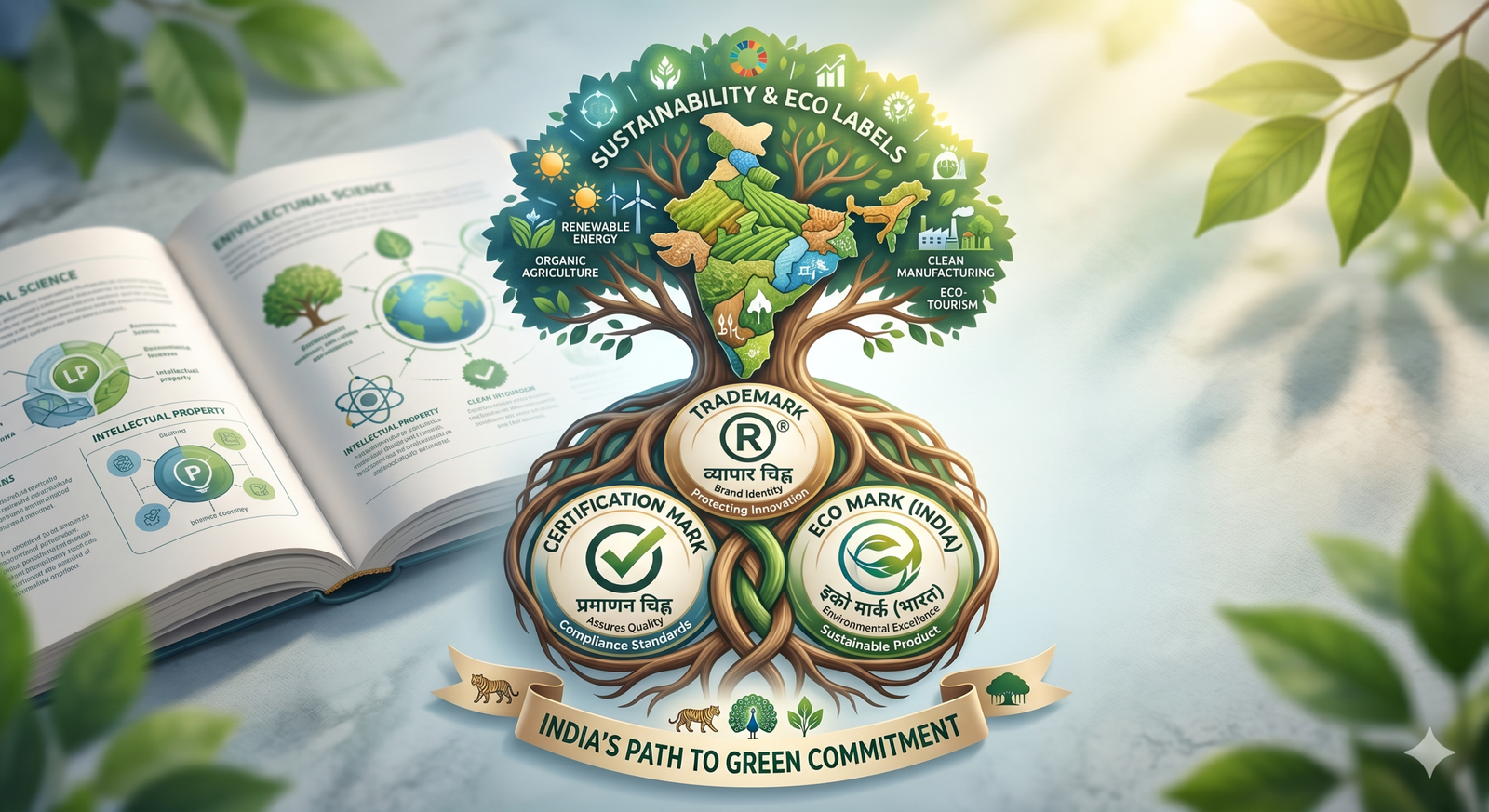
Sustainability and eco labels in India have moved from the periphery of brand strategy to its regulatory centre — and most brand teams have not yet fully absorbed what that shift requires of them.
Green claims are no longer creative copy. They are compliance statements — statements that are subject to trademark law, certification mark requirements, consumer protection regulation, advertising standards, and competition law simultaneously. For brand owners making environmental claims in India, the question is no longer whether to take the legal framework seriously. It is whether the legal framework is being managed with the integration and rigour that the current enforcement environment demands.
Furthermore, the stakes have risen significantly. Greenwashing scrutiny is intensifying globally and in India specifically. The consequences of weak, ambiguous, or substantively unsupported eco label use now extend well beyond reputational damage — to regulatory intervention, class actions, procurement disqualification, and sustainable finance access restrictions. For foreign brands entering India and for multinational brands managing sustainability positioning across jurisdictions, this is a live strategic and compliance question that requires immediate attention.
India’s Eco Mark Framework: What Has Changed and Why It Matters
Sustainability and eco labels in India operate within a framework that has recently undergone significant revision — revision that brand owners and their legal advisors must understand before making any environmental claims in the Indian market.
India’s Eco Mark scheme, originally introduced in the 1990s, has been updated through new certification rules that align the framework with the government’s Lifestyle for Environment mission. The updated scheme is administered through the Bureau of Indian Standards and covers a significantly expanded range of product categories — from food and cosmetics to textiles, electronics, household goods, and beyond.
Products carrying the Eco Mark label must meet defined environmental criteria and quality standards that are verified through BIS certification processes. The mark is not self-declaratory — it requires third-party verification against prescribed technical criteria. Consequently, any brand that uses imagery, language, or design elements that imply Eco Mark status without having obtained certification is operating in territory that consumer protection and advertising regulation treats as potentially misleading.
Additionally, the updated framework creates a new clearance obligation for brand owners. Green branding that references environmental criteria covered by the Eco Mark scheme must be assessed not only for trademark distinctiveness and conflict with existing marks but also for its relationship to the Eco Mark categories. A brand element that implies certified environmental compliance in a product category where the Eco Mark scheme operates creates both a trademark risk and a consumer protection risk — simultaneously and independently.
Certification Marks, Private Green Labels and the Trademark Law Dimension
Sustainability and eco labels in India do not operate through a single regulatory channel. They operate through at least three overlapping legal frameworks that interact in ways that brand strategy processes rarely account for systematically.
The first framework is India’s trademark law. Under the Trade Marks Act, 1999, certification marks are a distinct category of registered mark — marks that certify that goods or services meet defined standards of quality, accuracy, material, mode of manufacture, or other characteristics. Private green certification marks, such as GreenPro, operate within this framework. They signal that an independent certifying body has verified compliance with specified environmental or performance benchmarks.
For brand owners, the trademark law dimension of sustainability and eco labels in India creates both protection opportunities and conflict risks. A well-structured certification mark programme provides legally enforceable rights against unauthorised use of the mark. However, it also creates opposition and infringement risks for brands whose own marks or taglines are confusingly similar to existing certification marks in relevant product categories.
The second framework is consumer protection and advertising regulation. The Consumer Protection Act, 2019 and the Advertising Standards Council of India’s guidelines on environmental claims both address whether green claims are truthful, substantiated, and non-misleading. A brand that uses eco label imagery or environmental taglines without adequate substantiation creates consumer protection exposure that is independent of its trademark position. Specifically, claims that imply third-party certification without actual certification, claims that overstate the environmental benefit of a product, and claims that are technically accurate in one market but misleading in the Indian regulatory context all create liability that trademark clearance alone will not identify or prevent.
The third framework is competition law. The Competition Act, 2002 may become relevant where access to certification schemes is structured in ways that discriminate against market participants, where certification mark licensing terms create barriers to entry, or where the collective use of eco labels by industry participants has market distortion effects. This competition law dimension is not yet extensively developed in Indian practice — but it is a feature of the EU’s approach to sustainability labelling that is increasingly influencing how Indian regulators and courts approach similar questions.
The Greenwashing Risk That Most Brand Governance Processes Are Not Managing
Sustainability and eco labels in India create a greenwashing risk profile that most brand governance processes were not designed to manage — because most brand governance processes were designed before greenwashing became a regulated category rather than a reputational concern.
The greenwashing risk in the Indian context operates at several levels simultaneously. At the product level, specific claims about environmental performance, certification status, or origin-linked sustainability characteristics must be substantiated against the applicable regulatory standard — which varies depending on whether the claim relates to Eco Mark criteria, BIS standards, sector-specific environmental regulations, or advertising standards guidelines.
At the brand level, house marks and brand identities that have been built around sustainability positioning — through names, logos, taglines, or design elements that connote environmental responsibility — create ongoing obligations to ensure that the brand’s actual environmental performance is consistent with the impression the brand creates. A brand that positions itself as sustainable through its visual identity and marketing communications, but whose products do not meet the environmental standards implied by that positioning, creates greenwashing exposure that no trademark registration can protect against.
At the governance level, multinational brands managing sustainability positioning across multiple jurisdictions face the additional challenge of ensuring that their environmental claims are consistent across markets. A claim that is legally compliant and substantively accurate under EU Green Claims Directive standards may create different obligations and different risks under Indian consumer protection law. Internal governance frameworks that address green claims jurisdiction by jurisdiction — rather than as a globally coordinated exercise — create the risk of inconsistent positions that regulators and litigants in any individual market can exploit.
Practical Implications for Foreign Brands and Multinational Operations in India
Sustainability and eco labels in India create specific practical obligations for foreign brands entering the Indian market and for multinationals managing India as part of a global sustainability strategy.
The first obligation is clearance. Green branding developed for international markets must be assessed against the Indian Eco Mark framework, existing Indian certification marks, and Indian trademark registrations before deployment in India. This clearance exercise must ask not only whether the proposed mark conflicts with existing trademarks but also whether it implies Eco Mark or certification mark status that has not been obtained — and whether it makes environmental claims that are substantiated under Indian consumer protection standards.
The second obligation is contract architecture. Licensing agreements, distribution arrangements, and co-branding contracts involving eco labels and certification marks must address quality control obligations, audit rights, consequences of non-compliance, and termination provisions with specificity. A licensing arrangement that allows a licensee to use an eco label or certification mark without maintaining the standards that the mark certifies creates both legal liability and reputational risk for the licensor — liability that generic licensing agreement templates almost never adequately address.
The third obligation is internal governance alignment. Environmental claims made in India must be consistent with claims made in other jurisdictions — and must be reviewed against the specific regulatory standards applicable in India, not only against the standards of the brand’s home market. Furthermore, as greenwashing enforcement develops in India, brands that have established governance frameworks for green claim substantiation will be significantly better positioned than those that address claims on a campaign-by-campaign basis.
Eco Labels as a Competitive Advantage — Not Only a Compliance Burden
Sustainability and eco labels in India are not only a compliance challenge. For brands that build credible, well-governed eco label strategies, they represent a genuine competitive advantage in several commercially significant contexts.
Public procurement in India is increasingly incorporating sustainability criteria — creating preference or mandatory requirements for products that carry recognised eco certifications. B2B procurement processes in sectors such as manufacturing, retail, and financial services are incorporating supplier sustainability assessments that reward certified environmental performance. Sustainable finance instruments — green bonds, sustainability-linked loans, and ESG-aligned investment structures — increasingly require credible IP and certification frameworks as conditions of access.
Consequently, a brand that has invested in obtaining and maintaining Eco Mark certification, in building a legally sound certification mark strategy, and in substantiating its environmental claims against applicable standards is not merely managing compliance risk. It is building a commercial asset that creates access to procurement channels, financing instruments, and partnership opportunities that are increasingly significant in India’s evolving sustainability economy.
The Integration Imperative
Sustainability and eco labels in India require trademark strategy, certification mark compliance, consumer protection substantiation, and competition law assessment to be conducted as an integrated exercise — not as sequential or independent workstreams.
The brands that navigate this landscape most effectively are the ones that treat green claim governance as a cross-functional discipline — one that connects IP counsel, regulatory counsel, marketing teams, and sustainability officers around a shared framework for what can be claimed, what must be certified, and what must be substantiated before any environmental claim reaches a consumer or a regulator.
The regulatory environment around sustainability and eco labels in India will continue to develop. The brands that build integrated governance frameworks now will be significantly better positioned when that development accelerates — as it will.

Comments are closed