




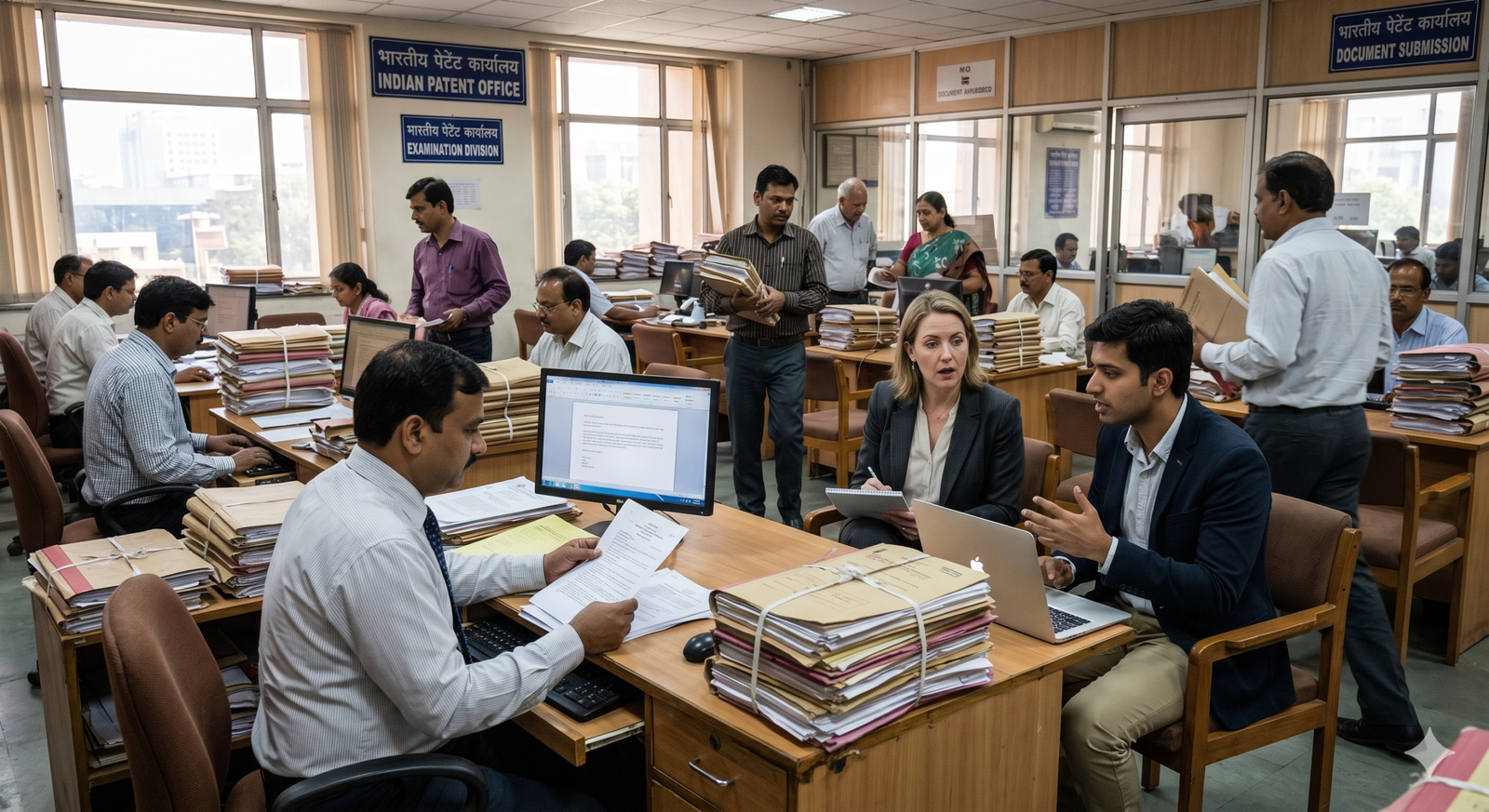
Patent prosecution in India has changed substantially over the last several years.
The Indian Patent Office has reduced its backlog significantly. Examination timelines have shortened. The quality of examination has improved. Examiners are more thorough, more technically qualified, and more willing to raise substantive objections on novelty, inventive step, and Section 3 exclusions.
This is broadly good for the Indian patent system. It is challenging for applicants and their counsel who have not updated their understanding of how Indian prosecution actually works today.
The Request for Examination Deadline
Under Rule 24B of the Patents Rules 2003, a request for examination must be filed within forty eight months of the priority date or the filing date, whichever is earlier.
This deadline is absolute. It cannot be extended. If the request for examination is not filed within forty eight months, the application is treated as withdrawn.
Applications that are being managed from a foreign jurisdiction, where the docket team is focused on US, European, or PCT deadlines, sometimes miss this deadline entirely. It does not trigger a reminder in some foreign docketing systems. It is not visible in the PCT portal in the same way that national phase entry deadlines are tracked.
When the application is treated as withdrawn for failure to file a request for examination, there is no mechanism to revive it under Indian law. The patent right is gone.
The Six Month Response Deadline
When the Indian Patent Office issues a first examination report, the applicant has six months to file a response. This deadline can be extended by three months on payment of the prescribed fee. The total maximum period is nine months.
If no response is filed within this period, the application is deemed abandoned.
In some foreign prosecution workflows, the first examination report arrives at the foreign attorney’s office, gets forwarded to the client for technical input, sits in an email queue, comes back, goes to the docketing team, gets assigned to a local Indian associate, and by the time a response is prepared, the window has closed or the extended window is about to close.
Nine months sounds like a long time. In a multi jurisdiction prosecution workflow with multiple stakeholders, it passes quickly.
Indian prosecution requires a tighter response timeline than many US or European prosecution teams are accustomed to managing.
Hearing Notices Under Section 14
If the examiner is not satisfied with the applicant’s response to the first examination report, the examiner can issue a hearing notice under Section 14 of the Patents Act 1970.
The hearing is an oral proceeding before the examiner or a senior examiner. It is not merely a formality. The examiner can and does raise new objections at the hearing. The applicant must be prepared to respond to objections that were not in the original first examination report.
Foreign counsel who are unfamiliar with Indian practice sometimes treat the Section 14 hearing as a routine formality. It is not. A poorly handled hearing can result in a refusal of the application. A well handled hearing can result in grant with minimal amendments.
Indian counsel who regularly appear before the Indian Patent Office knows how to prepare for a Section 14 hearing, what arguments the examiner is likely to raise, and how to present the case in the format and with the authorities the examiner expects.
This is practical knowledge that comes from experience in Indian prosecution. It is not something that can be reliably managed from a foreign office by correspondence alone.
The Working of Patents Requirement
Section 146 of the Patents Act 1970 requires every patentee and every licensee to submit a statement of working of the patent in India on Form 27. This form must be filed every financial year, covering whether the patent has been worked commercially in India, the quantum of working, and whether the working was through manufacture in India or through importation.
This requirement is often overlooked by foreign patentees who have no active presence in India.
The consequence of non filing is a fine. More significantly, a patent that is consistently reported as not worked in India is vulnerable to a compulsory licence application under Section 84. Any person can apply for a compulsory licence three years after the patent is granted if the reasonable requirements of the public with respect to the patented invention are not satisfied.
The compulsory licence provision in Indian patent law received global attention in the Bayer v Natco case in 2012, where a compulsory licence was granted for a patented cancer drug on the ground that the patented product was not available to the public at a reasonably affordable price.
A foreign patentee that holds a valuable patent in India but ignores the working requirement and the compulsory licence risk is leaving a significant strategic exposure unmanaged.
The Pre Grant Opposition as a Prosecution Tool for Competitors
Once an Indian patent application is published, typically at eighteen months, any person can file a pre grant opposition under Section 25(1).
Competitors in the pharmaceutical, chemical, and technology sectors in India use pre grant opposition strategically. It is a cost effective way to challenge a patent before it is granted. It places the burden on the applicant to respond to the opposition as well as to the examiner’s objections.
A startup or a foreign company that does not monitor the Indian patent landscape for competitor filings in its technology area, and that does not watch for its own published applications entering the opposition window, can be caught unprepared by a well researched and well timed opposition.
The correct response is to engage Indian patent litigation counsel to monitor the application, prepare for the possibility of opposition, and if an opposition is filed, respond with the depth of argument that the process requires.
A pre grant opposition is not a mere administrative hurdle. It is an adversarial proceeding with skilled opponents on the other side.
Why Indian Prosecution Needs Dedicated Attention
The pattern I see repeatedly is this.
A foreign company or a startup files in India as part of a global portfolio strategy. The filing decision is made centrally. The India prosecution is handed to a local associate who gets instructions from the foreign lead attorney but not much strategic guidance.
The local associate files responses but does not have the full business context to push back on claim scope, to advise on Section 3 risks proactively, or to flag the working requirement as a strategic consideration.
The patent is either not granted, granted in an unduly narrow form, or granted and then left unmanaged.
India is the world’s fifth largest economy. Its domestic innovation ecosystem is growing rapidly. Its domestic litigation capability, including patent litigation before the Delhi High Court and the Intellectual Property Appellate Board, is sophisticated.
A patent portfolio strategy for India that is built with the same care and attention as a US or European portfolio will generate real value. One that treats India as a secondary filing jurisdiction to be managed minimally will generate minimal protection.
If you are a startup building a global patent portfolio, or a foreign counsel managing India prosecution for a client and want a more active India strategy, I would welcome a conversation.

Comments are closed