




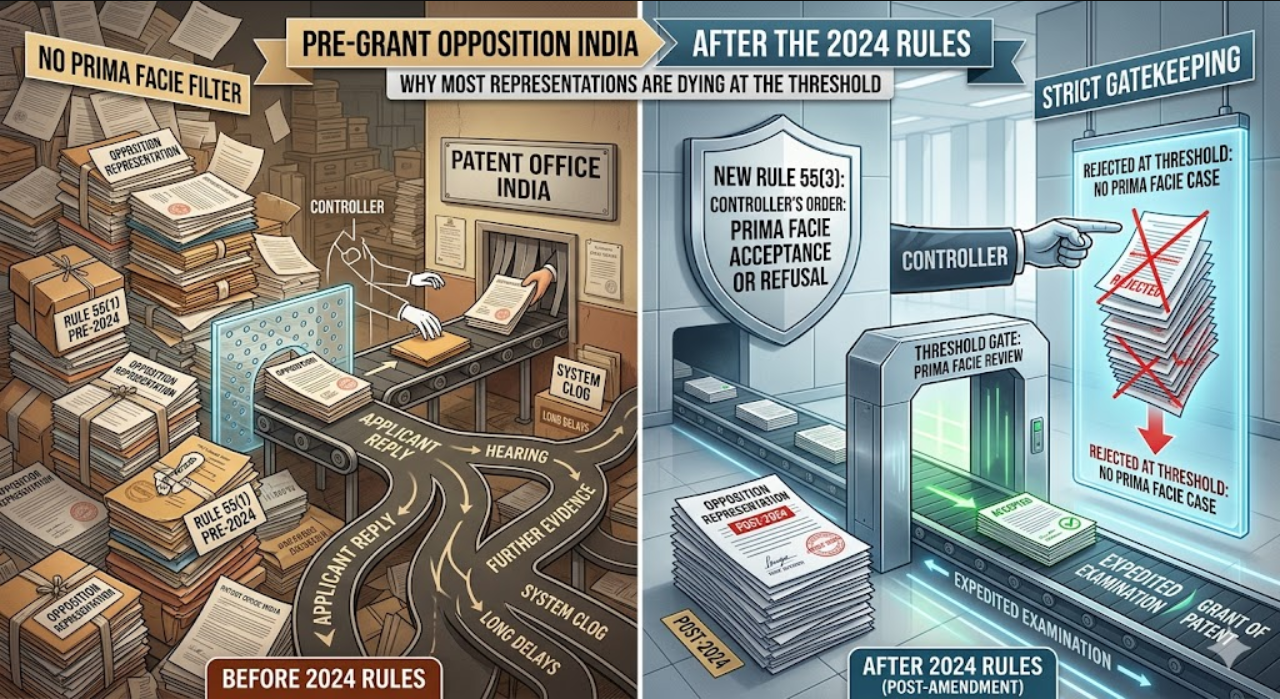
Pre-grant opposition practice in India changed structurally on 15 March 2024, and most practitioners filing representations are still drafting as if it did not.
The Patents Amendment Rules, 2024 introduced a gatekeeping mechanism under the amended Rule 55(3) that did not exist under the old practice. The Controller must now record a reasoned order on the prima facie tenability of the opposition before the patentee is ever called to reply. If no prima facie case is disclosed in the representation, it is dismissed at the threshold unless the opponent specifically requests a hearing. The patentee may never see a Rule 55(4) notice. The proceeding ends before it begins.
The representations being filed by well-funded generics, representations that would have sailed through to a hearing under the old Rule 55, are dying at this threshold. Not because the underlying invalidity arguments are bad. Because the representations were drafted for a proceeding that no longer exists in the form it used to take.
What the Old Practice Was and What Changed
Under the pre-2024 practice, the pre-grant opposition representation functioned as a trigger. Once filed, it put the patentee on notice, initiated the parallel proceeding, and set up the hearing at which both sides would develop their positions. The hearing was where the case was really made. The representation got the proceeding started. Counsel on both sides understood that the representation was the opening move, not the complete case, and they budgeted and drafted accordingly.
The Division Bench of the Delhi High Court in Novartis AG v. Natco Pharma Limited, judgment dated 9 January 2024, had already clarified important aspects of the pre-grant opposition framework before the rules were amended. Rule 55(5) confines the right of hearing to the adjudication of the representation itself. A right to be heard on the representation does not translate into a participatory right for the opponent in the examination process. Examination and opposition are parallel but independent streams. The Court emphasised that preserving the legislative intent includes preventing abuse of the pre-grant opposition right and avoiding undue delays.
The amended Rule 55(3) moved the threshold structurally beyond what the Novartis clarification required. The prima facie tenability determination now occurs before the patentee is involved. The representation must stand entirely on its own, without the benefit of the patentee’s reply to sharpen the issues or the hearing to develop the arguments. What the opponent puts in the representation is everything the Controller reads when deciding whether the proceeding advances at all.
The Three Drafting Failures Killing Pre-Grant Oppositions
From the perspective of practitioners arguing these matters from both sides of the table, three categories of drafting failure are consistently responsible for representations that do not survive the Rule 55(3) threshold.
The first is pleading grounds without pleading foundational facts. Section 25(1) lists the grounds available to a pre-grant opponent. Under the old practice, naming the ground and gesturing at the prior art was enough to get the proceeding started, with the substantive development to follow at the hearing. Under Rule 55(3), naming the ground without the foundational facts that make it arguable does not establish a prima facie case. Novelty pleaded without identifying a specific anticipatory disclosure, with the relevant passage identified and mapped to the application claims, does not clear the threshold. Obviousness pleaded without identifying the person skilled in the art, without articulating the problem the invention addresses, and without building the problem-solution analysis that shows why the solution would have been obvious to that person, does not clear the threshold. Section 3(d) pleaded against a pharmaceutical patent without comparative efficacy data does not clear the threshold. Insufficient disclosure pleaded without analysis of a specific passage of the specification does not clear the threshold. These representations were always weak. Under the old practice they survived to the hearing. Under Rule 55(3) they do not.
The second failure is drafting the representation to be completed at the hearing. The old practice trained practitioners to file a representation that opened the issues and rely on the hearing to develop the arguments, fill the gaps, and respond to the patentee’s position. That practice is now structurally incompatible with Rule 55(3). The gatekeeping standard operates before the patentee is heard. Every annexure, every citation, every claim mapping, and every expert opinion must work standing alone, without the benefit of cross-examination, rebuttal, or oral development. The representation that relies on the hearing to fill the analytical gaps it contains is the representation that gets dismissed without a hearing.
The third failure is under-investment in the representation because the economics of the old practice made front-loading the case seem inefficient. Generics and their counsel who were accustomed to spending modestly on the representation and more heavily on the hearing preparation are discovering that the amended rules have inverted that calculus. The representation is now the case. The case must be litigation-ready on day one. The total cost of a professionally built pre-grant opposition has increased, but the expected value of that investment is also substantially higher because the representation that clears the Rule 55(3) threshold has a much stronger chance of advancing to a meaningful proceeding.
What Patentees Must Do Differently
For patent applicants facing a pre-grant representation under the amended rules, Rule 55(3) is a structural advantage that is being underused by applicants and their counsel.
The amended rule operates symmetrically. It requires the Controller to record reasons whether accepting or rejecting the representation at the prima facie stage. A Controller who advances a representation to the patentee without recording a reasoned prima facie tenability finding has skipped a mandatory step, and that skip is a ground for challenge. Patentee’s counsel should affirmatively insist on Rule 55(3) reasoning at every stage. The prima facie order forms the record on which any subsequent challenge will be argued and the patentee whose counsel secured a properly reasoned order at the threshold is in a materially better procedural position than one who did not.
Beyond the procedural insistence on proper reasoning, patentee’s counsel should read every representation that arrives against the three threshold standards. Is there a claim-by-claim mapping of the prior art against the application? Is there a prior art passage specifically identified for the anticipation ground? Is there comparative pharmacological data for the Section 3(d) ground? Is there a specific passage of the specification analysed for the insufficiency ground? The absence of any of these is the threshold defect that ends the proceeding, and patentee’s counsel who identifies it should move for dismissal at threshold rather than preparing a substantive defence on the merits. Winning without defending on the merits is the more efficient outcome and the 2024 amendment has made it available.
There is also a timeline point that patentees routinely miss. The Controller’s obligation to make the prima facie determination is not subject to an unlimited deferral. An opposition that sits on the docket without a prima facie finding keeps the proceeding alive without advancing it. That limbo is itself harmful to the applicant whose prosecution is proceeding in parallel. Delay in the prima facie determination, where it operates to hold an opposition open without a finding, is a ground for writ relief, and patentee’s counsel should track this timeline with the same discipline they apply to FER response deadlines.
What Generics and Other Opponents Must Do Differently
For generics planning pre-grant opposition attacks under the amended rules, the representation filed in week one decides whether the proceeding advances at all. There is no second bite at the prima facie threshold. The expert affidavit, the prior art mapping, the efficacy analysis, and the claim-by-claim invalidity argument must all be in the box before filing.
For pharmaceutical patents, where Section 3(d) is the dominant pre-grant ground, the expert affidavit on enhanced efficacy is no longer an enhancement to the representation. It is the foundation without which the representation does not clear the threshold. A bare assertion that the patent claims a derivative of a known substance without evidence of significantly enhanced efficacy does not establish a prima facie case under the current standard. Generics planning Section 3(d) attacks need to budget for expert evidence at the representation drafting stage, not the hearing preparation stage.
For anticipation grounds under Section 25(1)(b), the threshold discipline is equally demanding. Citing a prior art document is not enough. The opponent must identify the specific passage of the prior art that discloses each element of the claim being challenged. It must map that passage claim by claim against the application. It must explain why the disclosure is enabling for the claimed subject matter. Patentee’s counsel reading the representation should look for this mapping first, because its absence is the threshold defect that justifies a motion for dismissal without substantive engagement.
The economics of pre-grant opposition under the amended rules have changed in a way that favours professionally built representations over speculative ones. The marginal opposition, filed to create procedural delay or to open a negotiating position without a fully developed invalidity case, now dies at threshold rather than advancing to a hearing where its weakness might be obscured. The opposition built with full expert evidence, complete prior art mapping, and a litigation-ready argument clears the threshold and proceeds to a proceeding where its strength is the deciding factor. The cost of building that representation has increased. The value of building it correctly has increased proportionally.
The Broader Signal for Indian Patent Litigation Practice
The 2024 amendment to Rule 55 is part of a broader pattern in Indian patent law that practitioners in this space are observing across multiple procedural contexts. The gatekeeping mechanisms are being tightened. Refusal orders must be reasoned at the level Fertin Pharma requires. Divisional applications must stand on specification disclosure that Syngenta demands. Pre-grant representations must establish prima facie tenability before advancing. In each context the message is the same. The procedural tool is available but only to the party who has invested in using it correctly from the start.
The era of the speculative pre-grant opposition filed to create procedural leverage without a fully built case is over. The era of the professionally built opposition, expensive at the front end, decisive when properly executed, has begun.
