




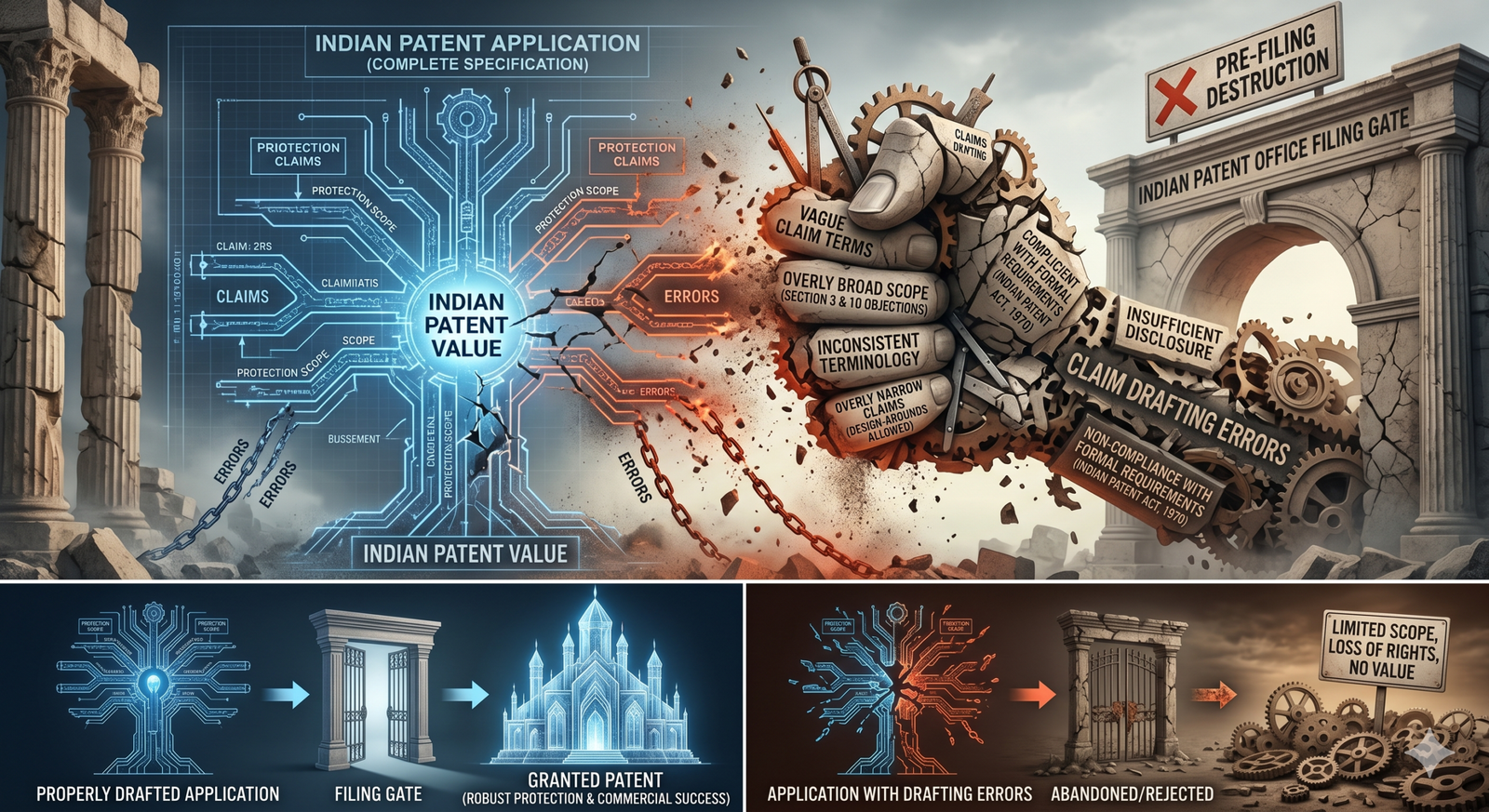
I reviewed a patent application last year that had been drafted by a competent attorney in another jurisdiction.
The claims were well structured by the standards of that jurisdiction. The independent claim was broad. The dependent claims cascaded neatly. The specification was clear and enabled.
In India, it was worth almost nothing.
Not because the invention lacked merit. The invention was genuinely novel and had strong commercial value in the Indian market. The problem was how the claims had been drafted in relation to Indian patent law, which differs from US and European law in ways that are not obvious until you are deep inside prosecution.
India Is Not a Clone of US or European Patent Law
Foreign attorneys and startups sometimes assume that if a claim survives US prosecution, a substantially similar claim will work in India. This assumption causes real damage.
The Patents Act 1970 has several provisions that operate very differently from 35 USC or the European Patent Convention.
Section 3 of the Patents Act contains a long list of what is not an invention under Indian law. The list includes mathematical methods, mental acts, algorithms as such, business methods, computer programs as such, discoveries, scientific principles, and methods of treatment of human beings and animals.
This is not the same as the US approach to patent eligibility under Section 101. The Indian provisions have their own body of case law and their own interpretive framework. A claim that was carefully structured to pass Section 101 scrutiny in the US may still fall squarely within Section 3(k) in India because the drafting technique used to get past the US examiner does not translate to Indian practice.
Section 3(d) applies specifically to pharmaceuticals and creates an additional layer of scrutiny for known substances. It has no direct equivalent anywhere else in the world.
Section 2(1)(j) defines invention to include both novelty and inventive step, but the Indian definition of inventive step in Section 2(1)(ja) has a specific reference to technical advance and economic significance that shapes how obviousness arguments are framed. Claims that were not drafted with this framing in mind are harder to defend during prosecution.
India still permits a specific type of claim called an omnibus claim or a claim “as described herein.”
Many foreign drafted specifications do not include omnibus claims because they are not permitted or not useful in the filing jurisdiction. When the application enters the Indian national phase, no one thinks to add them because the prosecution is being driven from the foreign jurisdiction.
This is a missed opportunity. Omnibus claims in India can provide a broader safety net that covers the invention as disclosed, not just the invention as claimed in the independent claim. They are a tool specific to Indian practice that adds value at minimal cost if included at the right time.
The Product by Process Claim Risk
Indian courts and the Patent Office have taken a relatively conservative view of product by process claims.
If your claim defines a product entirely by the process used to make it, and if that process is the only way you have characterised novelty, you face a real risk in Indian prosecution that the examiner will treat the claim as a process claim and apply prior art accordingly.
This is not a universal rule. There is nuance in how the Indian Patent Office and the courts have handled these claims. But the risk is real enough that product by process claims drafted for a US or European strategy should be reviewed specifically for Indian prosecution viability before filing.
Claim Scope and the Freedom to Amend
Under Section 59 of the Patents Act 1970, amendments to claims during prosecution cannot go beyond what was disclosed in the specification as originally filed.
This is a standard principle. What makes India distinctive is how strictly it has been applied in prosecution.
If the specification was drafted narrowly around a specific embodiment, the applicant may find themselves unable to broaden the claim in response to a prior art rejection without introducing what the examiner treats as new matter.
The solution is upstream. The specification needs to be drafted with enough breadth and enough alternative embodiments to support claim amendment in multiple directions. A specification written only to support the exact claim as filed gives the applicant very little room to manoeuvre when prior art surfaces.
This drafting discipline is important in every jurisdiction. It is especially important in India because the examination timeline is long enough that prior art landscapes can shift, and because the examiner corps has become more thorough in recent years.
Computer Implemented Inventions
This is an area where claim drafting errors are most common and most costly.
The Indian Patent Office has issued guidelines on computer related inventions. Those guidelines have been revised multiple times. The current framework looks for a technical contribution, a technical effect, and a technical advance beyond the computer implementation itself.
A claim for a software implemented method that is drafted purely in functional terms, describing what the system does rather than how it achieves a technical effect, will face a Section 3(k) objection in India.
The drafting technique used in the US to satisfy the Alice framework is not the same as the drafting technique needed to satisfy the Indian CRI guidelines. They ask related but different questions.
A claim that passes US eligibility may still need significant redrafting to survive Indian examination. If the specification does not support that redrafting, the applicant is in serious difficulty.
If you are a startup with a software, pharmaceutical, chemical, or mixed technology invention, ask your Indian counsel to review the draft claims specifically for Indian law issues before the application is filed.
This review should cover Section 3 exclusions, claim support in the specification, the scope of the independent claim relative to the prior art landscape in India, and whether omnibus claims should be included.
This is a two to three hour engagement. It is not expensive. It changes the quality of what gets filed and it materially improves the odds of the application surviving examination intact.
When you file in India, the claims that worked in your jurisdiction are a starting point, not a finished product.
Indian patent law has its own structure. It requires claims to be adapted, not just translated.
An Indian co counsel who reviews claims before filing is not creating additional work. They are protecting your client’s investment and your firm’s reputation for delivering results in India.
If you want a second opinion on claims before filing in India, or if you have an application currently in prosecution facing claim objections, I am available for a consultation.

Comments are closed