




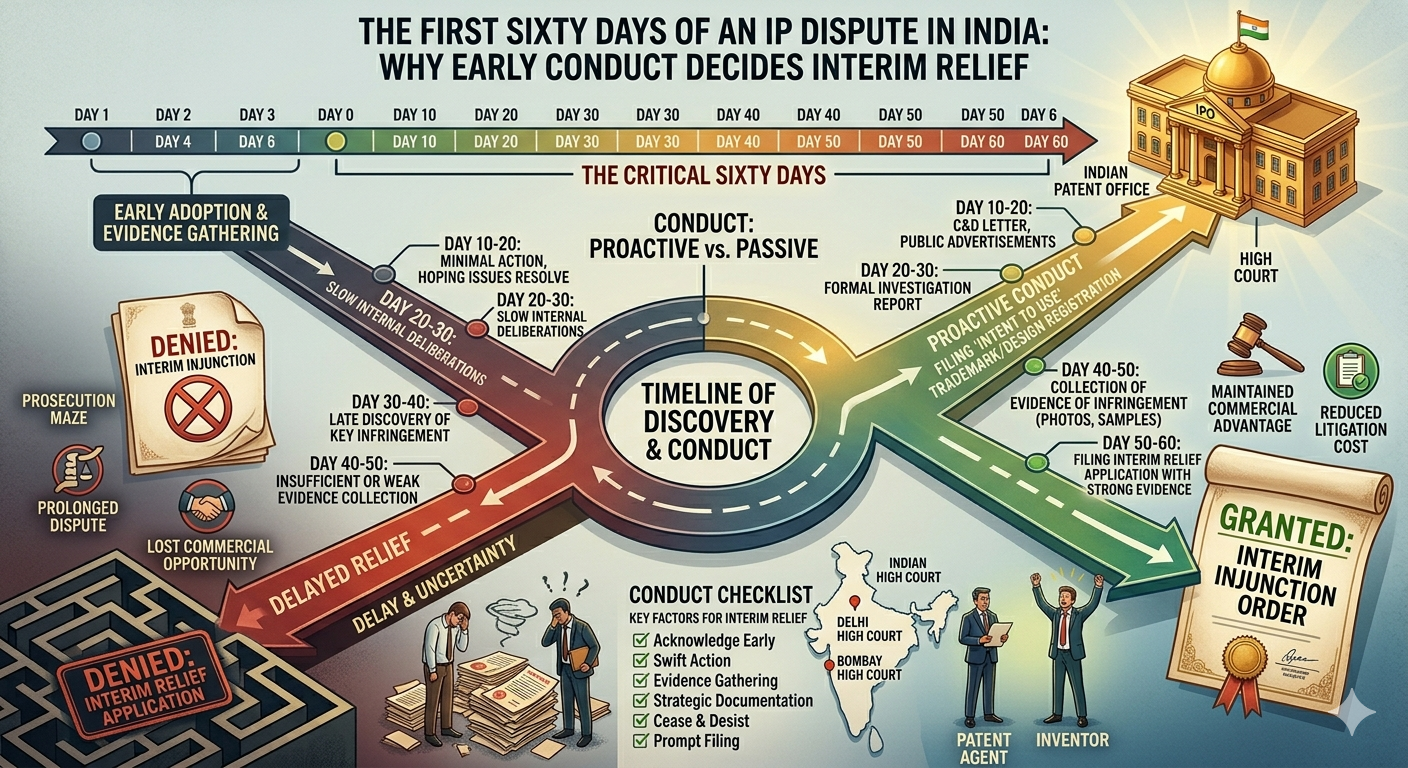
The first sixty days of an IP dispute in India are more consequential than most foreign counsel appreciate — and by the time that appreciation arrives, the window to act on it has usually closed.
From a distance, Indian IP litigation carries a reputation for slowness. Crowded dockets. Fragmented reporting of orders and hearings. News that reaches foreign clients in pieces, often weeks after the relevant hearing has concluded. This reputation is not entirely undeserved. Final judgments in complex trademark and technology disputes can take years. The volume of IP filings at the Delhi and Bombay High Courts has grown faster than judicial capacity has expanded, and the gap between filing and final resolution reflects that structural pressure.
What this reputation obscures, however, is how much is decided early. Interim orders in Indian IP disputes — particularly in trademark infringement, passing off, and technology disputes — shape commercial behaviour long before any final judgment is delivered. They determine whether a defendant can continue trading under a contested mark, whether infringing goods remain in distribution, whether a technology deployment can proceed while the underlying IP dispute is resolved. And the decisions that determine whether interim relief is granted or refused are heavily influenced by events that occurred not in the courtroom but in the sixty days between the moment infringement was first noticed and the moment the application for interim relief was filed.
How Indian Courts Read Interim Relief Applications
Understanding the first sixty days of an IP dispute in India requires understanding how Indian courts approach interim injunction applications in IP matters — and specifically what they are looking for beyond the standard legal tests.
The legal framework for interim relief in Indian IP disputes is well established. Courts apply a three-part analysis that assesses whether the applicant has established a prima facie case, whether the balance of convenience favours the grant of relief, and whether the applicant will suffer irreparable harm if relief is refused. These tests are familiar to foreign counsel from common law jurisdictions and do not, on their face, place particular weight on the timeline of the applicant’s pre-filing conduct.
In practice, however, Indian courts engage with a fourth dimension that the formal legal tests do not fully capture: the urgency of the application, assessed against the actual conduct of the applicant from the moment they became aware of the infringement. This assessment goes directly to the credibility of the irreparable harm argument. A court that is asked to grant urgent interim relief on the basis that every day of continued infringement causes irreparable damage to the applicant’s brand and goodwill will look carefully at what the applicant actually did in the period between noticing the infringement and filing the application. If that period reveals delay, internal indecision, or a pattern of conduct inconsistent with genuine urgency, the court’s willingness to accept the irreparable harm argument is significantly reduced — regardless of how strong the underlying case on the merits appears to be.
Furthermore, Indian courts specifically examine the doctrines of delay and acquiescence in trademark and passing off matters. An applicant who was aware of a confusingly similar mark operating in the market for a sustained period before seeking relief faces the argument that their delay amounts to acquiescence — an argument that can defeat an otherwise strong interim application even where infringement is clear.
What the First Sixty Days Actually Determine
The first sixty days of an IP dispute in India determine several things simultaneously — and most of them have nothing to do with the legal merits of the underlying claim.
They determine whether the urgency argument is credible. A court that reviews the timeline of an interim application and finds that the applicant noticed infringement in month one, instructed counsel in month two, and filed the application in month four is unlikely to accept that the situation is one of genuine urgency requiring immediate judicial intervention. The gap between awareness and action is read as evidence that the applicant did not themselves treat the matter as urgent — and courts are reluctant to treat as an emergency a situation that the applicant demonstrably tolerated for months.
They determine the quality of the evidentiary record available at the interim stage. The first sixty days are when internal documentation is created — or not created. Emails recording the moment infringement was first noticed. Internal notes documenting the assessment of the threat and the decision to take legal action. Correspondence with distributors, retailers, or commercial partners who have observed the infringing activity. Records of consumer confusion, if any has been reported. This documentation, created contemporaneously with the events it records, carries significantly more evidentiary weight than reconstructed accounts prepared for litigation. Courts are experienced at distinguishing between records that were maintained in the ordinary course of business and records that were assembled after the decision to litigate had already been made.
They determine the scope of the factual narrative available to the applicant’s counsel. An interim application filed on the basis of a well-documented sixty-day record gives Indian counsel a precise, chronological account of awareness, assessment, and action that can be presented to the court as a coherent factual narrative. An application filed without that record requires counsel to work from a reconstruction that the court may find incomplete, inconsistent, or difficult to reconcile with the publicly observable timeline of infringement.
Additionally, they determine the realistic scope of settlement discussions. Interim orders, once granted, significantly affect the settlement dynamics of Indian IP disputes. A defendant restrained by an interim injunction is in a materially weaker negotiating position than one who has successfully resisted interim relief. The first sixty days — and the quality of the interim application they support or undermine — therefore affect not only the immediate judicial outcome but the entire commercial trajectory of the dispute.
A Pattern That Recurs in Cross-Border IP Disputes
The first sixty days of an IP dispute in India reveal a pattern in cross-border matters that, once recognised, is difficult to unsee.
A well-known foreign brand with a long history of use, a global portfolio in order, and clear evidence of a local defendant operating under a confusingly similar mark with a patchwork of local registrations. The foreign team prepares meticulously. They assemble evidence of international reputation, global sales figures, marketing expenditure, and press coverage that demonstrates the brand’s recognition across markets. They construct a narrative of confusion that is compelling on its own terms.
The Indian court, however, focuses on something more modest. It wants a precise timeline. When did the client first notice the infringing mark. What specific steps were taken in the first month following that notice. Why was the application for urgent relief filed when it was, rather than earlier. What internal records document the progression from awareness to legal action.
In that hearing, the outcome turns not on the strength of the global brand — which is not in dispute — but on the discipline of the first sixty days. Emails that were or were not sent. Internal notes that were or were not kept. Decisions that were taken and documented, and decisions that were taken without any contemporaneous record. The foreign team’s global narrative of confusion is compelling. The Indian court’s assessment of urgency and delay is decisive.
This is not an unusual outcome in cross-border IP litigation in India. It is a predictable one — and its predictability is precisely what makes structured early case management so commercially valuable for foreign clients with Indian IP exposure.
How Structured Early Case Management Changes the Outcome
The first sixty days of an IP dispute in India can be managed deliberately — and managing them deliberately changes what is possible at the interim relief stage.
The starting point is building a calendar of events from day zero. This means identifying, with as much precision as the available documentation supports, the exact moment at which the client first became aware of the infringing activity. Not the moment at which external counsel was instructed. Not the moment at which the internal legal team escalated the matter. The moment of first awareness — wherever it occurred and however it was recorded — is the anchor point of the entire subsequent timeline, and its precise identification is the first task of structured early case management.
From that anchor point, the calendar documents every significant event: internal assessments of the threat, decisions to monitor rather than act immediately and the reasons for those decisions, instructions given to external counsel, steps taken to gather evidence, communications with third parties who have observed the infringement, and any preliminary engagement with the defendant. Each event is recorded with its date, the individuals involved, and the documentation that supports it.
This exercise serves multiple functions simultaneously. It identifies gaps in the evidentiary record that can still be addressed — contemporaneous documentation that has not yet been created but can be, evidence that has not yet been gathered but should be, witnesses whose observations have not yet been recorded but remain available. It separates what is provable from what is merely assumed or recalled without documentary support. It gives Indian counsel a factual foundation from which to construct an urgency argument that will withstand judicial scrutiny. And it aligns the expectations of the foreign client, the international team, and Indian counsel on the realistic prospects for interim relief and the timing of any settlement opportunity.
Only after this exercise is complete does it make sense to engage in detailed analysis of the legal tests — passing off, infringement, delay and acquiescence, balance of convenience, public interest. The legal tests are applied to the facts. If the facts are not clearly established and documented, the most sophisticated legal analysis cannot compensate for the evidentiary deficit.
What This Means for Foreign Counsel and In-House Teams
The first sixty days of an IP dispute in India require foreign counsel and in-house teams to adopt a discipline that most international IP dispute management frameworks do not explicitly address.
The instinct of most international teams when infringement is identified is to assess the strength of the underlying IP rights, evaluate the commercial significance of the threat, and decide whether the matter warrants legal action. These are the right questions. They are not, however, the complete set of questions that Indian IP disputes require. The additional question — what is our evidentiary record of the first sixty days going to look like when an Indian court examines it on an interim relief application — needs to be asked at the outset, not after the application has been filed.
For in-house teams managing global IP portfolios with India exposure, this means building internal protocols for documenting infringement awareness and early response steps as a standard element of IP enforcement procedure — not as a India-specific addition but as a recognition that the evidentiary significance of early conduct is a feature of Indian courts that distinguishes them from many other jurisdictions where foreign teams are more experienced.
For external counsel advising foreign clients on India-facing IP disputes, it means making the first sixty days discussion an explicit part of the initial case assessment — before the strategy conversation, before the legal tests analysis, and certainly before any application for interim relief is drafted.
The strength of an international brand portfolio, the quality of global IP registrations, and the clarity of the infringement are all relevant to the outcome of Indian IP litigation. They are not, however, sufficient. Indian courts will read the conduct of the applicant from the moment awareness of infringement arose. Building a record that supports rather than undermines that reading is the work of the first sixty days — and it is work that cannot be done retrospectively.

Comments are closed